In stone handling, site cleanup, and supporting construction operations, the rotating stone / log grapple is a common attachment. Many people are familiar with the name, but do not clearly understand its structure or how it works. This article explains in simple terms what a rotating stone / log grapple is, how it works, and how it is structured, so you can quickly understand the basics.
1. What Is a Rotating Stone / Log Grapple
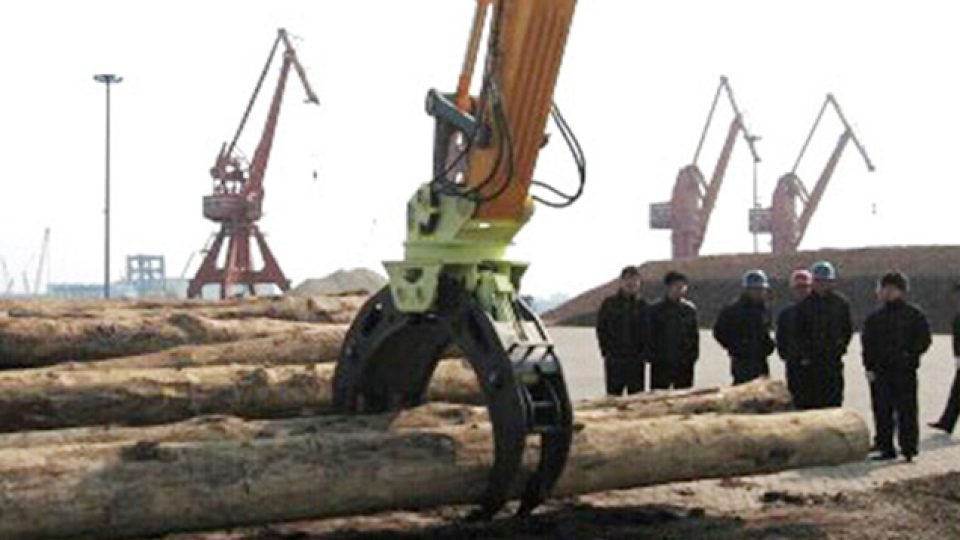
A rotating stone / log grapple is a grabbing attachment used together with a carrier machine, most commonly an excavator. It uses its own structure to grip stones or wood and adjust angles during operation. Its core feature is the rotating function, which allows the attachment to change grabbing direction while working, making it suitable for materials placed in different positions and helping meet multi-angle handling needs.
It is not a fixed-form grabbing device. Instead, it relies on the combination of hydraulic power and mechanical structure to complete its movements. It is mainly used for handling stones, logs, and similar materials. Its overall design centers on three main functions: grabbing, rotating, and connecting. This makes it a highly adaptable attachment for a wide range of jobsite applications.
2. Working Principle of a Rotating Stone / Log Grapple
The operation of a rotating stone / log grapple depends on the coordinated action of the hydraulic system and the mechanical structure. The overall process is straightforward and does not involve complicated or redundant design, so it is relatively easy to understand.
The carrier machine provides hydraulic power, which is transmitted to the rotation module and the grabbing module. After receiving power, the rotation module drives the lower grabbing structure to rotate in a circular direction, allowing the grapple opening to align with the target material. The grabbing module, driven by hydraulic power, controls the jaws to open and close. When closing, the jaws fit around the shape of the stone or wood to achieve a firm grip. When opening, the material is released.
During operation, the rotation movement and grabbing movement can be performed independently or used together. The operator can first adjust the angle and then grip the material, or grip the material first and then adjust its direction. With continuous hydraulic power supply, the structure maintains its working position and completes each handling cycle.
3. Overall Structure of a Rotating Stone / Log Grapple
The structure of a rotating stone / log grapple is made up of several parts. Each part has a clear function, and together they provide the complete working capability. The main structure can be divided into four sections: the connection mechanism, rotation mechanism, grabbing mechanism, and supporting/transmission components.
1) Connection Mechanism
This is the part that connects the grapple to the carrier machine. It is responsible for fixing the attachment in place and transmitting the basic operating force. Its structure mainly includes connecting parts and a mounting base. The dimensions match the interface of the carrier machine to ensure a stable connection. It is the basic support section of the whole attachment.
2) Rotation Mechanism
Located below the connection mechanism, this is the key structure for angle adjustment. It contains internal transmission and load-bearing parts and achieves rotation through hydraulic drive. It turns the grabbing mechanism below so that the attachment can change direction and meet material handling needs from different angles.
3) Grabbing Mechanism
This is the part that comes into direct contact with the stone or wood. It consists of multiple jaws, opening and closing brackets, and linkage shafts. The jaw shape is designed to suit gripping needs. With the coordinated action of the opening/closing brackets and linkage shafts, the jaws open and close under hydraulic power to grip and release the material.
4) Supporting and Transmission Components
These parts are distributed among the main structures of the attachment and play the roles of connecting, transmitting force, and bearing loads. They include bushings, link rods, hydraulic pipelines, and similar components. The hydraulic pipelines are responsible for delivering power, while the link rods and bushings help moving parts operate smoothly and maintain the structural stability of the whole machine, ensuring that the rotation and grabbing actions are completed in an orderly way.
4. Summary
A rotating stone / log grapple is a carrier-mounted attachment powered by hydraulics and equipped with both rotating and grabbing functions. Through the coordination of the connection mechanism, rotation mechanism, grabbing mechanism, and supporting/transmission components, it can grip materials and adjust handling angles efficiently. Its working principle is based on power transmission and structural coordination. The structural layout is clear and not overly complicated. Once the function of each part is understood, its operating logic becomes easy to follow.