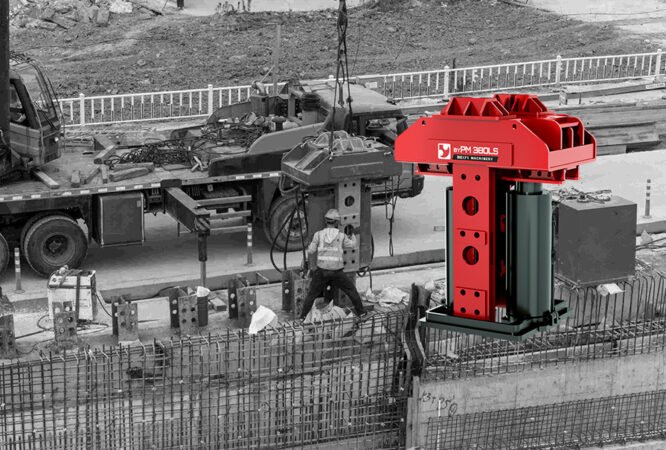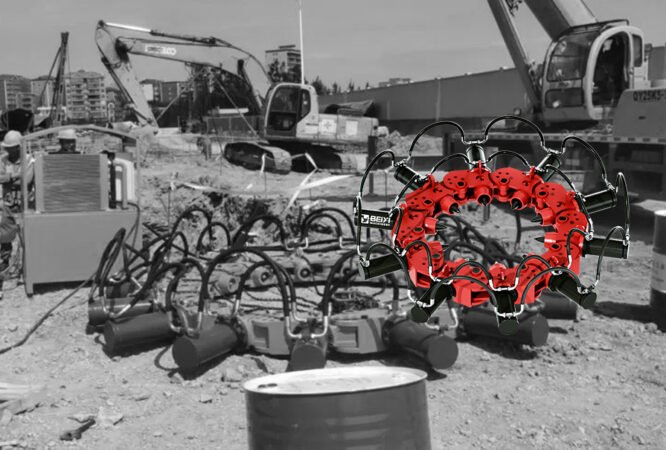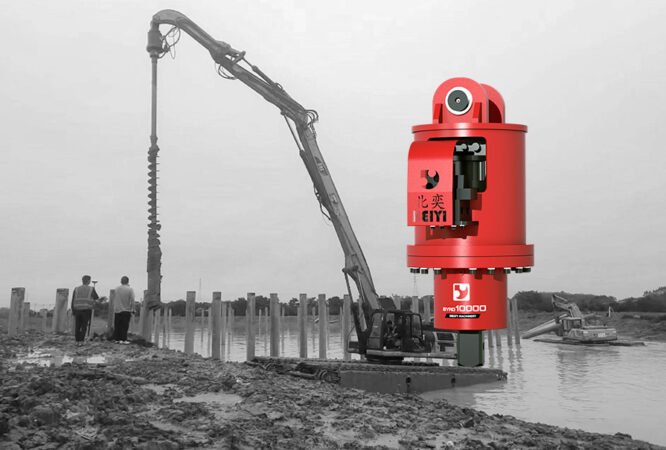
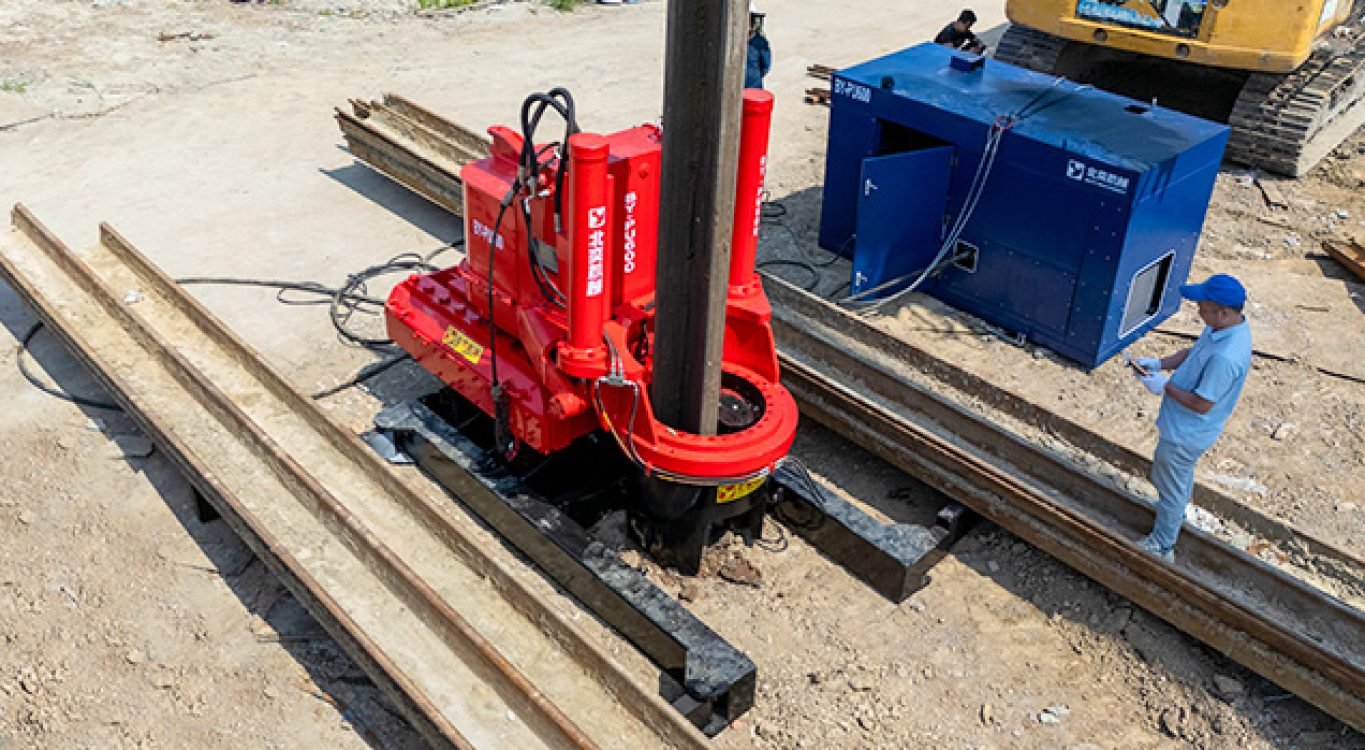
In working conditions adjacent to hospitals, schools, subways, historic buildings and underground pipelines, traditional piling “cannot afford to vibrate.” Starting from a real working case, this article breaks down how the Beiyi Hydraulic Static Pile Driver (static pile driver) drives Larssen sheet piles in quietly through the vibration-free press-in method.
You need to install Larssen sheet piles for excavation support next to an operating tier-3 hospital, with an operational subway tunnel just 8 meters below ground. The slightest ground vibration would cause image artifacts in the MRI suite, disturb patients, and even trigger an alarm on the subway structure monitoring system. For this job, neither the diesel hammer nor the vibratory hammer “can afford to vibrate.” Centered on the core question—how to drive sheet piles at a vibration-sensitive construction site—this article uses a real working case to walk through the answer from Beiyi’s Hydraulic Static Pile Driver (static pile driver).
1. First, define it: is your site “vibration-sensitive”?
A vibration-sensitive construction site is not a subjective feeling—it means the structures, equipment, or environment have a clear tolerance limit for ground vibration. Check the list below; if any item applies, you should be cautious with traditional kinetic piling:
- Medical & research: hospital wards, ICU, MRI / CT suites, and laboratory precision instruments—even tiny vibrations can affect diagnosis and data;
- Education & heritage: schools, kindergartens, historic buildings, museums—vibration easily causes cracks and public concern;
- Transport lifelines: adjacent to subway tunnels, viaduct piers, or existing railways—vibration may trigger structural monitoring alarms;
- Residential & commercial: dense housing or business districts—vibration brings complaints and stoppage risk;
- Underground pipelines: areas with dense gas, fiber-optic, and water pipes—low-frequency vibration may loosen joints.
2. Why traditional piling “cannot move an inch” in vibration-sensitive zones
Diesel hammers drive piles by high-frequency impact, and vibratory hammers by continuous vibration; both spread energy through the pile and the soil:
- Structural damage: neighboring building foundations suffer repeated dynamic loads and may develop micro-cracks, especially fragile historic structures;
- Equipment interference: hospital MRI and lab instruments are extremely vibration-sensitive—image artifacts and measurement drift are unacceptable;
- Transport risk: subway tunnel linings may alarm or even enforce speed restrictions under vibration;
- Social cost: the double disturbance of noise and vibration leads to complaints and potential work stoppage.
In short, in vibration-sensitive zones the “force” of traditional methods is applied in the wrong place—it spreads energy to exactly where you least want to move anything. To break the deadlock, you need a “non-disturbing” penetration method.
3. The solution idea: replace “vibration” with “pressing”
The core of the Beiyi Hydraulic Static Pile Driver is to use static pressure instead of impact and vibration. Its “press-in mechanism” is completely different from kinetic piling:
- Reaction force: the machine grips several already-driven, stable “completed piles” and uses their extraction resistance as the reaction base;
- Static pressing: a precise hydraulic system applies continuous vertical static load to press the next sheet pile smoothly into the ground—no impact, no vibration throughout;
- Self-propelled advance: after the first pile is pressed in, the machine “grabs” the completed piles as a new reaction base and moves forward by itself, without frequent crane assistance and without the extra disturbance from a bulky counterweight.
Tip: Solution tip: For hard soil, sandy layers, or old foundations, you can add water-jet assisted pressing (high-pressure water jet to loosen the soil), turning a “geological hard bone” into a configurable equipment parameter so you can still press steadily to the bottom in sensitive zones.
4. How the Beiyi solution holds the “zero-vibration” line
Challenge: Safeguard 1: “zero disturbance” to buildings and subways
Solution: The press-in mechanism releases no shock waves into the surrounding soil, with ground vibration close to zero. For an 8-meter-deep subway tunnel and adjacent hospital foundations, it is a near-zero dynamic-load penetration, mechanically avoiding structural damage and monitoring alarms.
Challenge: Safeguard 2: no disturbance to MRI and precision instruments
Solution: With no continuous low-frequency vibration transmitted, hospital MRI and lab instruments will not be “shaken” into artifacts or drift, so diagnosis and research can continue normally—something impact and vibratory methods cannot achieve.
Challenge: Safeguard 3: underground pipeline safety
Solution: Because it transmits no vibration, gas and fiber-optic joints 2 meters deep are not exposed to low-frequency resonance, so you need no extra vibration-protection measures and avoid leakage risk.
Challenge: Safeguard 4: low noise, fewer complaints
Solution: Noise comes only from the hydraulic power unit itself, far below traditional piling hammers, allowing normal operation in noise-restricted zones and cutting the “vibration—complaint—stoppage” chain.
5. Landing the real case: excavation support next to a hospital and subway
Case Scenario: Case profile: A new hospital campus of a tier-3 hospital in a city needs excavation support on the side adjacent to an operating ward building (with an MRI suite); Larssen sheet piles (Type IV) of 12–15 m are to be installed. About 8 m below is an operational subway tunnel, surrounded by residential areas.
Hard constraints: zero vibration (protect MRI / subway), zero complaints (protect residents), sandy-soil geology, narrow working face.
For this job, we recommend the combination of BY-PU600 standard pressing configuration + water-jet module + wireless remote control:
| Item | Selection & Parameters | Role in vibration-sensitive zones |
| Main unit | BY-PU600, pressing force 900 kN / extraction force 1100 kN | Vibration-free stable pressing of Type IV sheet piles, strong enough for hard layers |
| Pile type | U-shaped sheet pile 400–600 mm (Type II/III/IV) | Matches 12–15 m support pile length |
| Assist method | Water-jet assisted pressing module | Breaks through sandy layers, avoids abnormal vibration from pile jamming |
| Operation | Wireless remote / manual control panel | Precise control of verticality & pressing-force curve away from the building |
| Speed | Pressing 2.6–35.7 m/min | Continuous operation, controllable schedule |
| Mobility | Self-propelled, main unit ~6,945 kg (7,345 kg with water jet) | Flexible in narrow faces, no frequent crane assistance |
Tip: Construction checklist: ① Before mobilization, verify the subway tunnel and pipeline survey map and mark the vibration-control red line; ② After the first pile, advance self-propelled using the “completed piles” as reaction; ③ Grade water-jet pressure by sandy-layer thickness to avoid abnormal pressure; ④ Monitor verticality and pressing force in real time via wireless remote, stop on anomaly. Following this, you can complete the support piles first-time-right under “zero vibration, zero complaints.”
6. Reference to a similar real project
This kind of vibration-sensitive case is not isolated. In the Xi’an Urban Underground Comprehensive Pipe Gallery Project, a similar static press-in method was used in the Lin-tong District section of Renmin Road—the pipe gallery centerline runs directly below the road, with Type IV Larssen sheet piles (12–15 m) for earth retention, adjacent to existing buildings and municipal pipelines. It was accomplished precisely because of the traits of “no vibration, low noise, and strong adaptability to narrow and complex conditions.” It shows that as long as you treat the static pile driver as a “solution platform” and configure it on demand, sheet-pile jobs next to hospitals, subways, and schools can all be taken on.
7. Three frequent questions about driving sheet piles in vibration-sensitive zones (FAQ)
Q1: Next to a subway tunnel and hospital MRI, can the static solution really achieve “zero vibration”?
A: It can reach a “negligible” level. The Beiyi Hydraulic Static Pile Driver uses the “press-in mechanism” rather than impact / vibration; the pressing force is transmitted through a closed loop via the already-driven piles, releasing no shock waves into the surrounding soil. For an 8-meter-deep subway tunnel and adjacent ward building with an MRI suite, it is a near-zero dynamic-load penetration—this is exactly why it can be adopted in projects next to hospitals, schools, and subways. We recommend installing vibration-monitoring points before construction to prove “controllability” with data to the owner and the subway authority.
Q2: Vibration-sensitive zones demand higher sheet-pile verticality; can static pressing guarantee accuracy?
A: Yes, and it is better than kinetic methods. The pressing process is smooth with no rebound; BY-PU600 supports real-time monitoring of pressing force, verticality, and penetration depth via wireless remote, equivalent to a “static load test” during construction. Deviation can be detected and corrected immediately, giving more stable pile verticality and water-stop effect—critical for retention and seepage control next to structures, avoiding later leakage and rework.
Q3: Using static pressing in vibration-sensitive conditions—how much more does it cost than traditional methods, and is it worth it?
A: Look at the total account. The single-pile equipment cost of static pressing is slightly higher, but it saves the cost of vibration-protection supports for neighboring buildings and protection for subways / pipelines; more importantly, it avoids the most expensive chain of complaints—stoppage—compensation, and lets hospital diagnosis and subway operation “keep running.” In conditions adjacent to MRI, subways, and schools, traditional methods are often “cheap but unable to do it” or “able but at a greater cost.” For vibration-sensitive projects, the static solution is usually superior in overall economy and controllability—what you buy is not just a machine, but a “quiet-construction permit.”
Want a static solution for your next vibration-sensitive job?
Send us the project location, adjacent objects (hospital / subway / school), pile length, and geology, and Beiyi will provide a full-process solution from condition diagnosis, pile-type matching, and assist-method selection to on-site technical support. Let sheet piles be pressed in quietly, even in the most vibration-sensitive places.